 Petal Home
Home / Blog / Start Your Christmas Present List Now: Who, What and How Much
Start Your Christmas Present List Now: Who, What and How Much

Christmas present shopping gets harder when the list starts late, someone gets forgotten, or spending creeps up without you noticing. Early November is a useful point to get the basics down before the sales get louder. A present list doesn't need to be clever. It needs the people, a rough budget for each, somewhere to drop ideas, and a way to see what's already bought.
The quick answer
- List the people first, not the presents
- Give each person a budget, plus one overall number
- Collect ideas over the coming weeks, then decide
- Tick things off when they're bought, and keep track of what's hidden where
- Keep it private where it needs to be, so surprises stay surprises
1. List the people first
Start with names, not presents. Write down everyone you've decided you want to give something to, including any neighbours, teachers, childminders or other people your family personally includes. It's much easier to notice a gap in a list of names than in a list of gifts. Then mark anyone you'd rather not buy for individually this year, such as a group gift, a family Secret Santa or a card only.
2. Give each person a budget
Decide the numbers before you see anything tempting. Choose an overall amount you're comfortable with, then split it between people. It doesn't have to be equal, and it doesn't have to be precise. It just has to be a number you chose calmly, in November, rather than one you reach by accident in December.
3. Collect ideas, then decide
Ideas arrive at odd moments, like a comment in the car or something a child points at in a shop. Keep one place to drop them, and don't decide yet. Once you've collected a few ideas, go through them before you start shopping and decide which ones are genuinely worth keeping. It helps to note what each person actually asked for, what would be a nice surprise, and the size or colour if it matters.
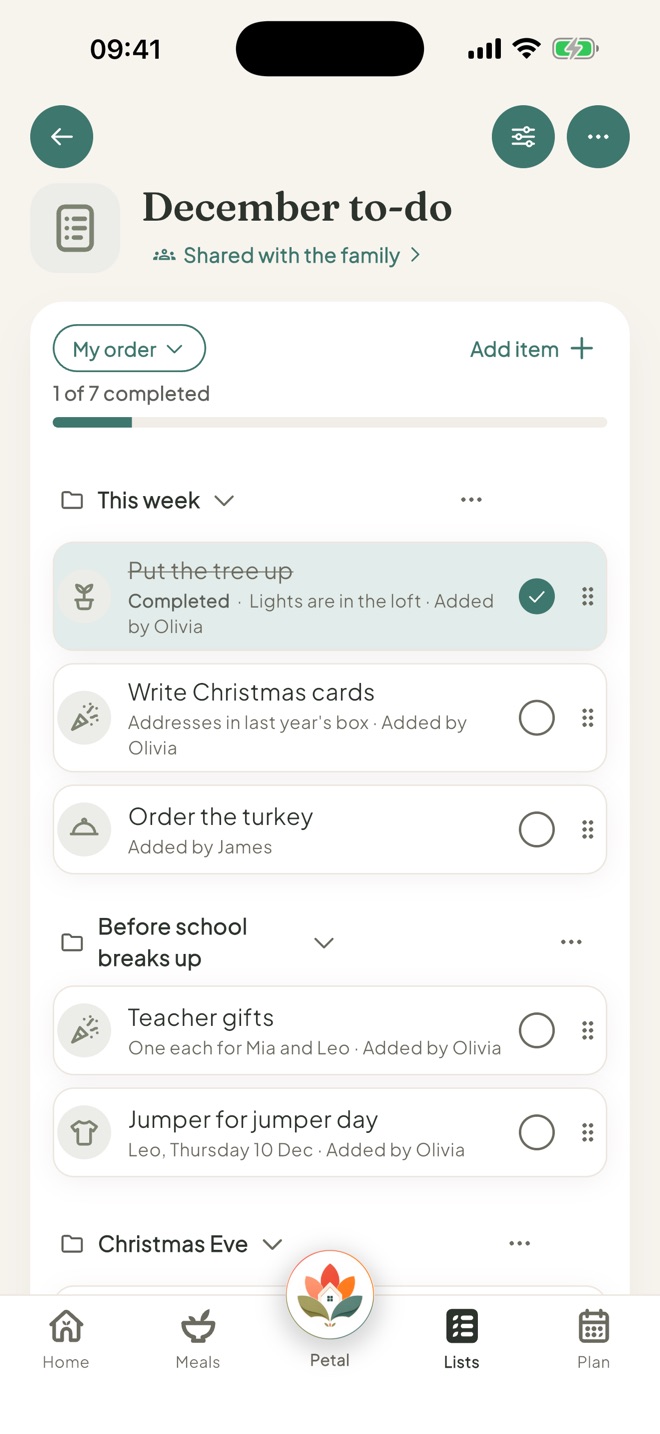
In Petal Home, a blank list is free, and you can add items, put them in sections (one per person works well), add a note to an item and tick things off. On a shared list, each item shows who added it. Everyone in the household can add to it, which is handy for grandparents' ideas or a child's wishlist.
If you want more structure, the Premium Presents template adds gift-specific details such as who an item is for, priority, price and a link, plus budgets for the whole list and for individual people. It can then show what you've spent and what remains as presents are ticked as bought.
4. Track what's bought and where it's hidden
Once the ideas turn into decisions, the list becomes a tracker. Tick each present as you buy it, and add a note for anything that needs a next step, like "ordered, arriving Friday", "needs wrapping" or "hidden in the wardrobe". A quick look at the list before you shop again stops doubles and gaps.
- Idea: on the list, not yet decided
- Decided: you know what it is, and roughly what it costs
- Bought: ticked, with a note if it hasn't arrived
- Wrapped and hidden: a note of where, so it doesn't turn up in February
5. Keep the surprise
A shared list is convenient, but not everything should be seen by everyone. For presents for other people in the household, use a list only some people can see. In Petal Home, you can limit a list to chosen people, and that's free. If you're planning something for a partner, a private list keeps it to yourself. Keep children's wishlists on a list the household can see, so grandparents and other adults can contribute.
6. Decide before the sales
Sales can be useful for things you've already decided to buy, but a discount only helps if the item and the price make sense for your list. They're a poor moment to decide what to buy. If the list is written first, a deal only matters if the item is on it. Our guide to a calmer family Christmas covers the wider plan, from shared jobs to how to keep it kind.
A present list doesn't need to be perfect or complete on day one. Names and a rough budget is a good start. The rest can fill in over the next few weeks.
Frequently asked questions
When should I start Christmas shopping for presents?
Early November is a good time to start the list, before the sales begin. You don't need to buy anything yet. Write down the people, set a budget for each, and collect ideas over the next few weeks.
How do I set a Christmas present budget?
Choose an overall amount first, then divide it between the people you're buying for. It doesn't need to be equal or precise. It's a number you chose in advance, so you're not deciding in the middle of a sale.
Can Petal Home track a Christmas budget?
With Premium, the Presents template lets each item carry who it's for, a priority, a price and a link to where to buy it, and the list can hold an overall budget and a budget for each person, showing what you've spent and what's left. A blank list is free.
How do I keep Christmas presents a surprise on a shared list?
Use a list that only some people can see. In Petal Home, you can limit a list to chosen people, which is free. Keep children's wishlists on a list the household can see so relatives can add ideas.
One calm place for the whole family
Petal Home is being built to help families keep meals, lists, calendars and reminders in one calm shared space. If that sounds useful for your household, you can join the waitlist and we'll let you know when it launches.
Join the waitlist