 Petal Home
Home / Blog / Share housework fairly, without the nagging
Share housework fairly, without the nagging

In plenty of households, the visible housework is shared reasonably well. What often isn't shared is the remembering. One person carries the running list of what needs doing and when, and that job never appears on any rota.
The quick answer
The fastest way to share housework fairly without nagging is to take the reminding out of it. In Petal Home:
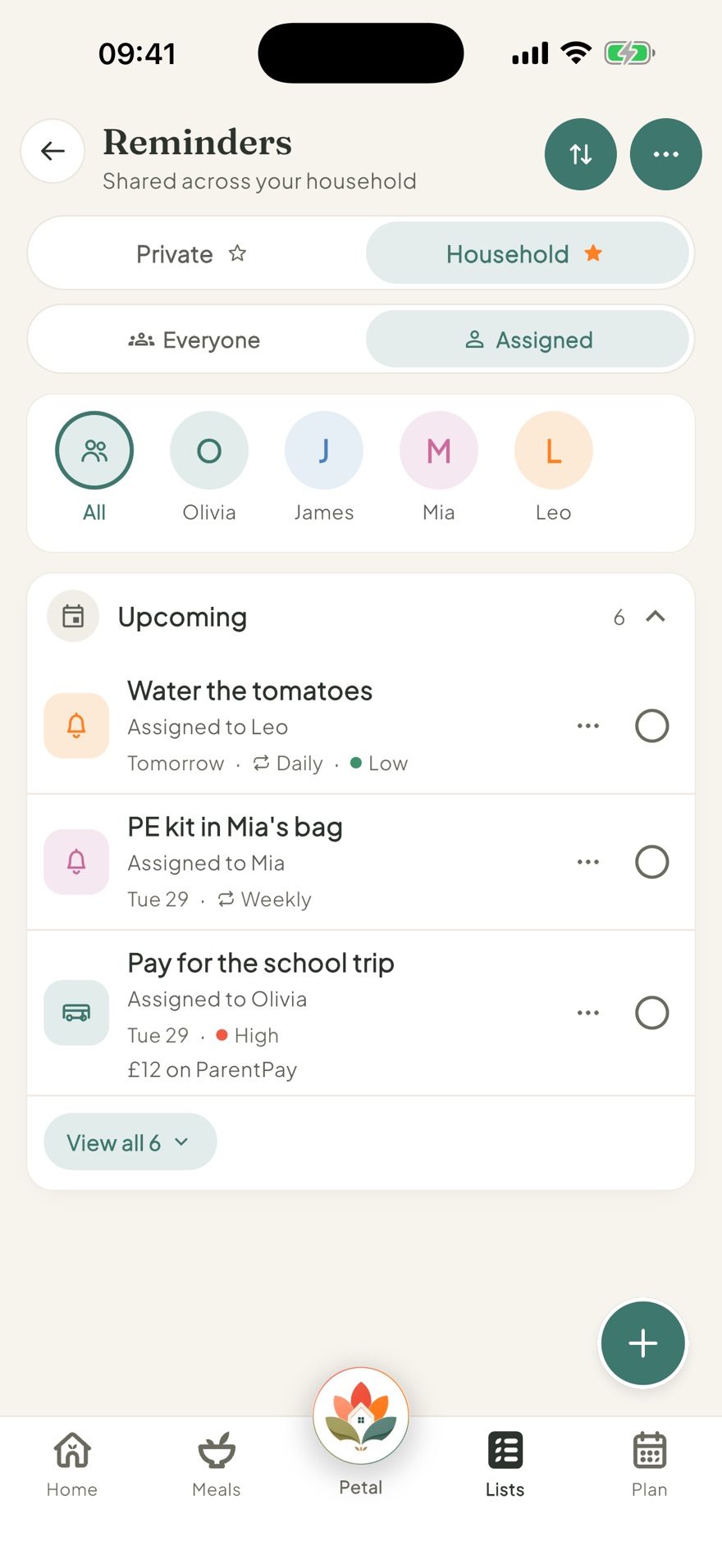
- Assign a household reminder to someone, and the nudge goes to their phone, not everyone's; for a little one without their own account, it comes to you instead
- Recurring jobs repeat automatically (daily, weekly, monthly, or on the days you choose), so bins and similar chores never need re-entering
- Hand over whole areas rather than alternating a rota, so the person doing the job starts noticing it themselves
- Private reminders for your own things, household ones for shared jobs, and per-person controls for what children can see
It's on track to launch towards the end of 2026, free with the option to upgrade to Premium.
It's also the job that causes the friction. Not the hoovering. The asking about the hoovering. This is often called the mental load: the planning, anticipating and remembering that sits around the visible job itself.
The asking is the work
If you've ever been told "you only had to ask", you'll know why that lands badly. Having to ask is the thing. Working out that the bins need doing, choosing the moment, phrasing it so it doesn't sound like a telling off, then remembering whether it actually got done. That's four jobs wrapped around one job.
Which is why rotas so often fail. A rota splits the visible work, then hands the invisible work straight back to whoever made the rota. They're now the person chasing it, which is exactly where they started, except now there's a chart on the fridge making them feel worse about it.
Write down what actually happens
Before splitting anything, it's worth seeing the whole of it. Not the tidy version, the real one.
Most households are surprised twice. First by how much there is. Then by how much of it is small, invisible and constant, which is the sort that never gets counted because it doesn't look like a task.
- The daily ones: dishes, tidying, feeding people, feeding the animals
- The weekly ones: bins, washing, the shop, changing beds
- The ones nobody names: booking appointments, replying to the school, noticing the shampoo is nearly out
- The seasonal ones that always arrive at once: presents, uniform, the car, the boiler
That third group is usually where the imbalance actually sits. It's worth writing down even if you do nothing else, because it's very hard to share something nobody else can see.
Split it by what suits people, not by fairness
Fifty fifty sounds right, but equal isn't always the same as fair. People are different, schedules are different, and some jobs are genuinely worse for some people than others.
For many households, handing over whole areas works better than alternating turns. If a job belongs to you permanently, you start noticing it yourself, which is the whole point. If it alternates, somebody still has to keep track of whose turn it is, and you've reinvented the chasing.
A reasonable test: could you go away for a week without leaving instructions? If not, the jobs are shared but the noticing isn't.
Let something else do the nagging
This is the part technology is genuinely good at, and it has nothing to do with productivity. It's about taking the reminding out of a relationship.
A reminder that arrives on someone's own phone, at the time the thing needs doing, is doing the same job you were doing, without the tone. A notification is usually easier to receive than a partner asking a second time.
In Petal Home, reminders can be set for yourself or assigned to someone else in the household, and land as a notification on their phone when it's due, not whenever they happen to next open the app. Ongoing ones repeat daily, weekly, monthly, or on the days you choose: tick one off and it comes straight back for next time, so nobody's re-entering the bins every week. Miss one and it waits for you rather than quietly moving on without you.
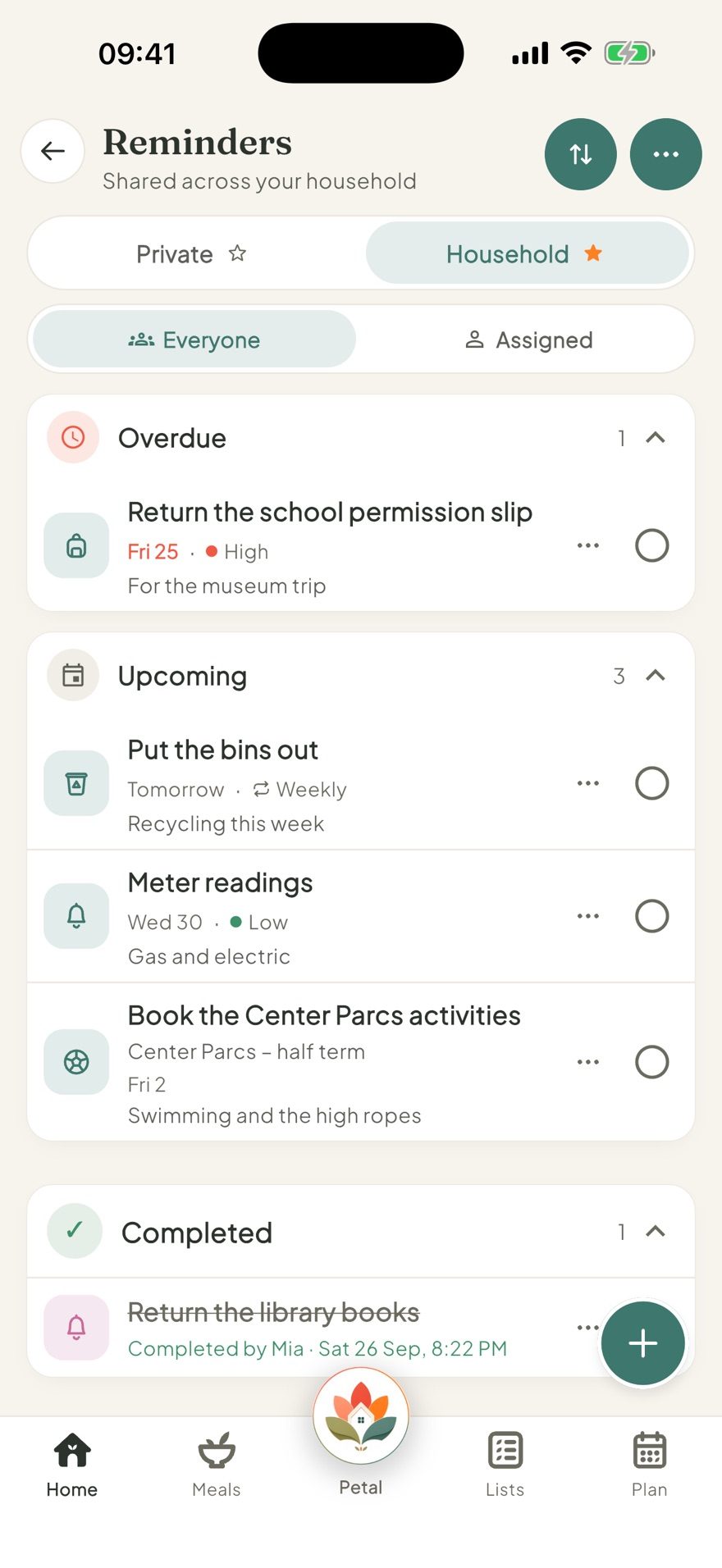
Some of these belong to the whole house and some are just yours, so reminders come in both. A private one for your own bits, a shared one when it's genuinely everyone's.
Children, without turning it into a job
Children can take on more than most of us hand over, but it works better when it's framed as being part of the household rather than as chores in exchange for something.
A few things that help: give the whole job rather than half of it, accept it will be done worse than you'd do it, and don't redo it in front of them. Match it roughly to age, and let it grow.
Petal has per person controls, area by area: a household admin chooses whether a child's access is hidden, view only, or full edit, so a younger member sees what's theirs without the whole household's admin, and nothing more than that.
Don't build a scoreboard
It's tempting to track who did what, especially if the split has felt uneven for a while. Tracking can show you the imbalance, but it rarely fixes it.
The moment there's a tally, every job becomes a point, and the conversation shifts from running a home together to proving something. Most households don't need a scoreboard. They need the invisible work to be visible, and the reminding to come from somewhere other than one person's patience.
And some weeks it won't work. Somebody's ill, or work goes sideways, and the jobs pile up regardless. That's not a failure of the system, it's just a week. A system that only works when everyone is at their best isn't much of a system.
If you change one thing
Make the invisible list visible. Sit down together, write out everything that actually keeps the house running, including the noticing, and look at it properly.
Most of the tension in this comes from one person believing they carry more than anyone realises, and usually nobody has ever seen it written down. Often, writing it down shows there was more invisible work than either person realised. Just seeing it changes the conversation, before you've moved a single job.
Petal Home brings the practical side of that together: reminders you can assign, jobs that repeat on their own, and a clear line between what's yours and what belongs to the household. The shop is usually part of this too, and a shopping list everyone actually uses solves a similar version of the same problem.
Frequently asked questions
How do I split housework fairly with my partner?
Don't aim for an even fifty-fifty split by task, it rarely holds. It's usually more durable to hand over whole areas permanently rather than alternate turns, so the person doing a job also starts noticing when it needs doing, instead of someone else having to remind them.
What is the mental load in a household?
The mental load is the thinking around household jobs: noticing what needs doing, planning it, remembering when it needs doing and checking it happened. The physical job might be shared while that planning work still sits mostly with one person.
How can reminders help share the mental load?
A reminder assigned to whoever's doing the job lands as a notification on their own phone when it's due, so the person who used to remember everything doesn't have to ask a second time. Ongoing ones repeat automatically, daily, weekly, monthly, or on the days you choose, so nothing needs re-entering.
What household jobs can children help with?
Give a child the whole job rather than half of it, match it roughly to their age, and let it grow over time. Per-person controls mean a child only sees what's theirs, and a household admin stays in charge of what they can access.
Do repeating reminders work for regular chores like bins?
Yes. Set a reminder to repeat daily, weekly, monthly, or on the days you choose, and ticking it off brings it straight back for next time rather than it needing to be re-entered. A missed one waits for you rather than quietly moving on without you.
One calm place for the whole family
Petal Home is being built to help families keep meals, lists, calendars and reminders in one calm shared space. If that sounds useful for your household, you can join the waitlist and we'll let you know when it launches.
Join the waitlist